Before You Give Up on Music, Study Triads
October 10, 2026
by eduardoA personal exploration of guitar triads on the top three strings: how inversions, repeating shapes and voice leading can help you hear chords differently.

For many of us, making music isn't as straightforward as we'd sometimes like it to be. At least for me, it's never been as simple as “pick up my instrument, play three or four chords, and poof! A song.”
Many of us struggle with this process. Making music involves experimenting, listening to our ideas, throwing them out, and trying again. It's a skill we develop over time, and yes, understanding how to use scales and chords to build a song is part of that learning process too.
But knowing these tools is one thing; understanding their musical possibilities is another. Scales and chords organize our raw material: notes. We can learn their formulas, memorize their positions, and even use them to compose, but that doesn't mean we've paid enough attention to the relationships between their sounds. We also need to develop an understanding of intervals, and that means stopping to listen to what happens when we move from one note to another, or from one chord to the next.
What led me to study triads, though, was a fairly basic discovery—something I'd never paid enough attention to. I knew how they were built, but I'd never stopped to listen to how the sound changed as I moved through the degrees of a scale, such as C major (Ionian), one chord at a time.
So if you feel stuck when trying to write your own songs, or you're simply looking for a way to better understand what your instrument can do, I'd like to suggest a small experiment: studying guitar triads and their inversions.
It's not just about learning more positions on the fretboard. It's about beginning to recognize the relationships between the notes and chords we already know.
1. What Are Guitar Triads and Chord Inversions?
When I started this little experiment, I wanted to recognize chord shapes and hear the interval relationships between them. I wanted to know how to navigate the fretboard and move through the same scale I already knew, but with chords this time.
A triad is a chord made up of three notes: a root, a third, and a fifth.
The root is the note we build the chord from. For example, in C major (C–E–G), C is the root, E is the third, and G is the fifth.
We can rearrange these notes to get root position and two inversions:
- Root position (1–3–5): the root is the lowest note.
- First inversion (3–5–1): the third is the lowest note.
- Second inversion (5–1–3): the fifth is the lowest note.
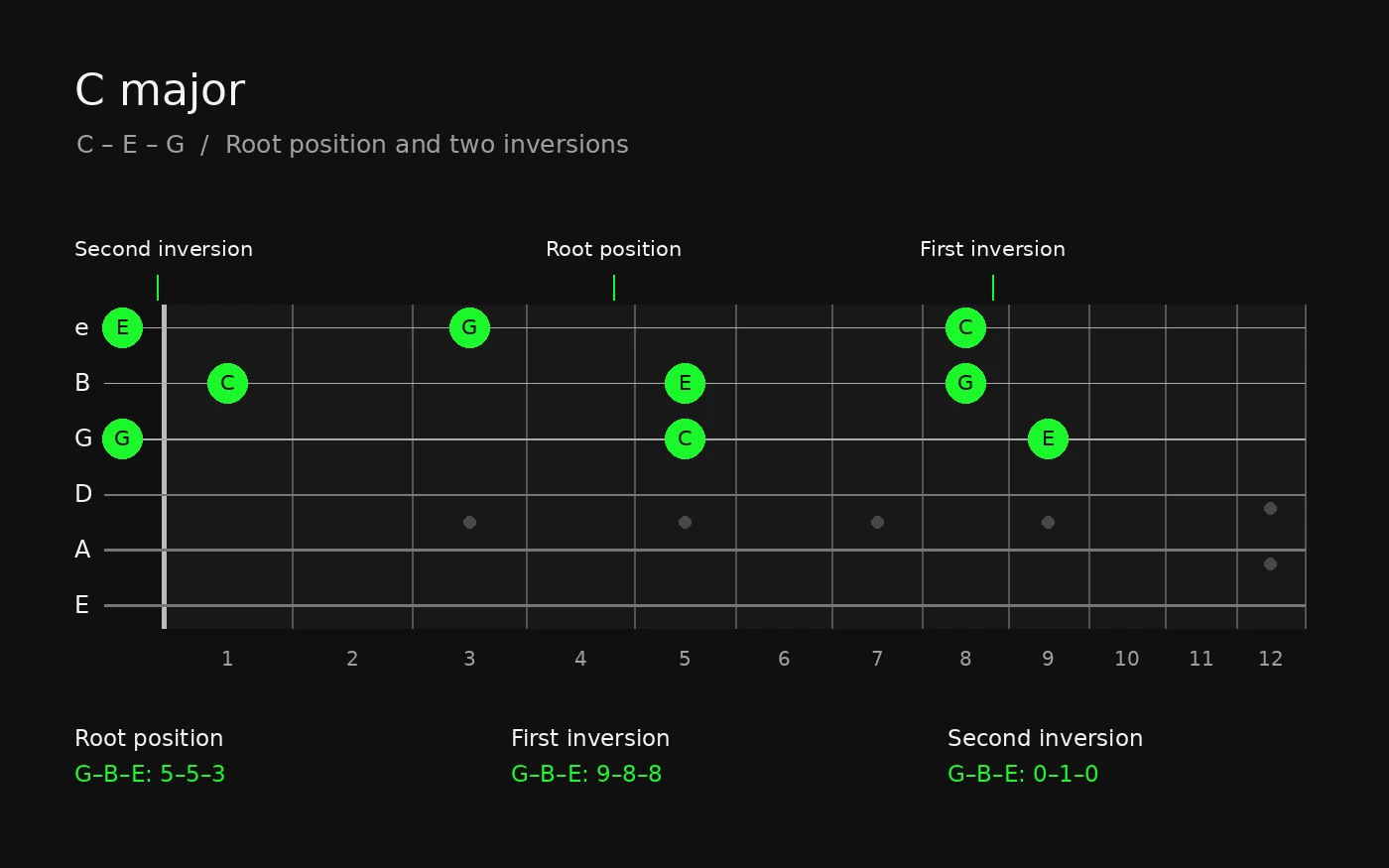
Here, 1, 3, and 5 identify the chord tones. The sequences describe the close-position arrangements we'll use in this study.
The lowest note is the one with the lowest pitch, not necessarily the first one we play.
To understand this on the guitar, we'll work exclusively with the first three strings and, for now, within the first twelve frets. All examples use standard tuning.
Strings are numbered from the thinnest to the thickest:
- First string (E): high E.
- Second string (B): B.
- Third string (G): G.
In this exercise, we'll play three notes, one on each string, forming the chord without doubling any notes. We'll look for close-position voicings: the notes will fit within a single octave.
In these positions, each string has a role:
- G (third string): carries the lowest note.
- B (second string): carries the middle note.
- E (first string): carries the highest note.
This lets us identify the inversion by looking at which chord tone we're playing on the third string.
Inversions vs. Voicings
Although they're related, they don't mean exactly the same thing.
An inversion tells us which chord tone is the lowest note. A voicing describes how all the notes are arranged, including how far apart they are.
For example, we can play C major as C–E–G or C–G–E, from low to high. In both cases, C is still the lowest note, so the chord remains in root position, even though its voicing changes.
In this study, we'll focus on root position and the two inversions with the notes grouped closely together.
2. Guitar Triad Shapes Repeat Across the Fretboard
The study went from wanting to know what these shapes looked like to thinking, “I think this is easier than I expected.” Because once you know the root-position shape and the two inversions of a chord—whether it's major, minor, or diminished—you've already solved part of the problem: you can reuse those shapes elsewhere on the fretboard.
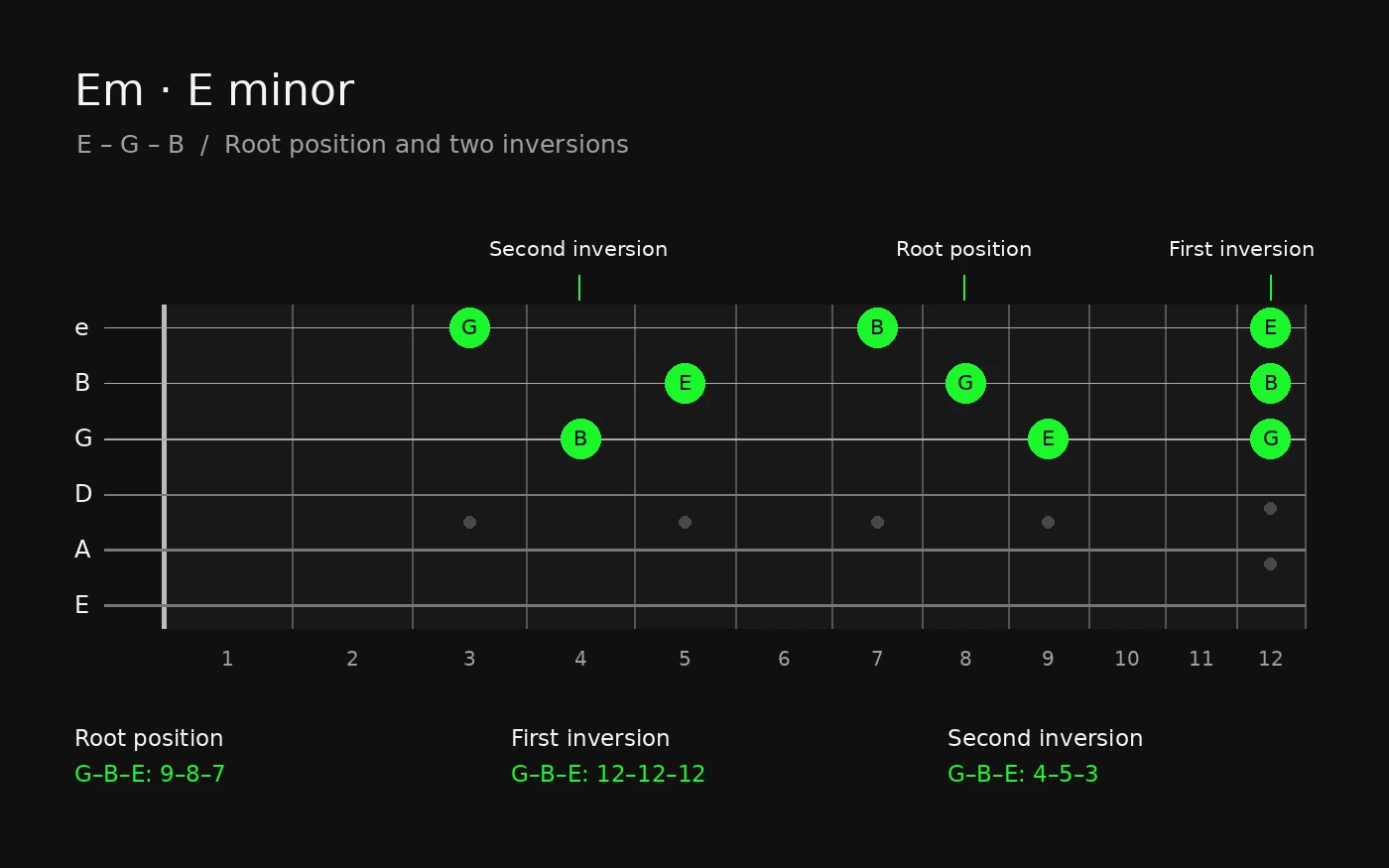
For example, if we learn the three positions of Em, we can move those same shapes along the fretboard to play other minor chords, such as Dm or Am.
We just need to locate the root, third, and fifth of the new chord. We can do this by moving along a single string and using the appropriate note as a reference to place each shape.
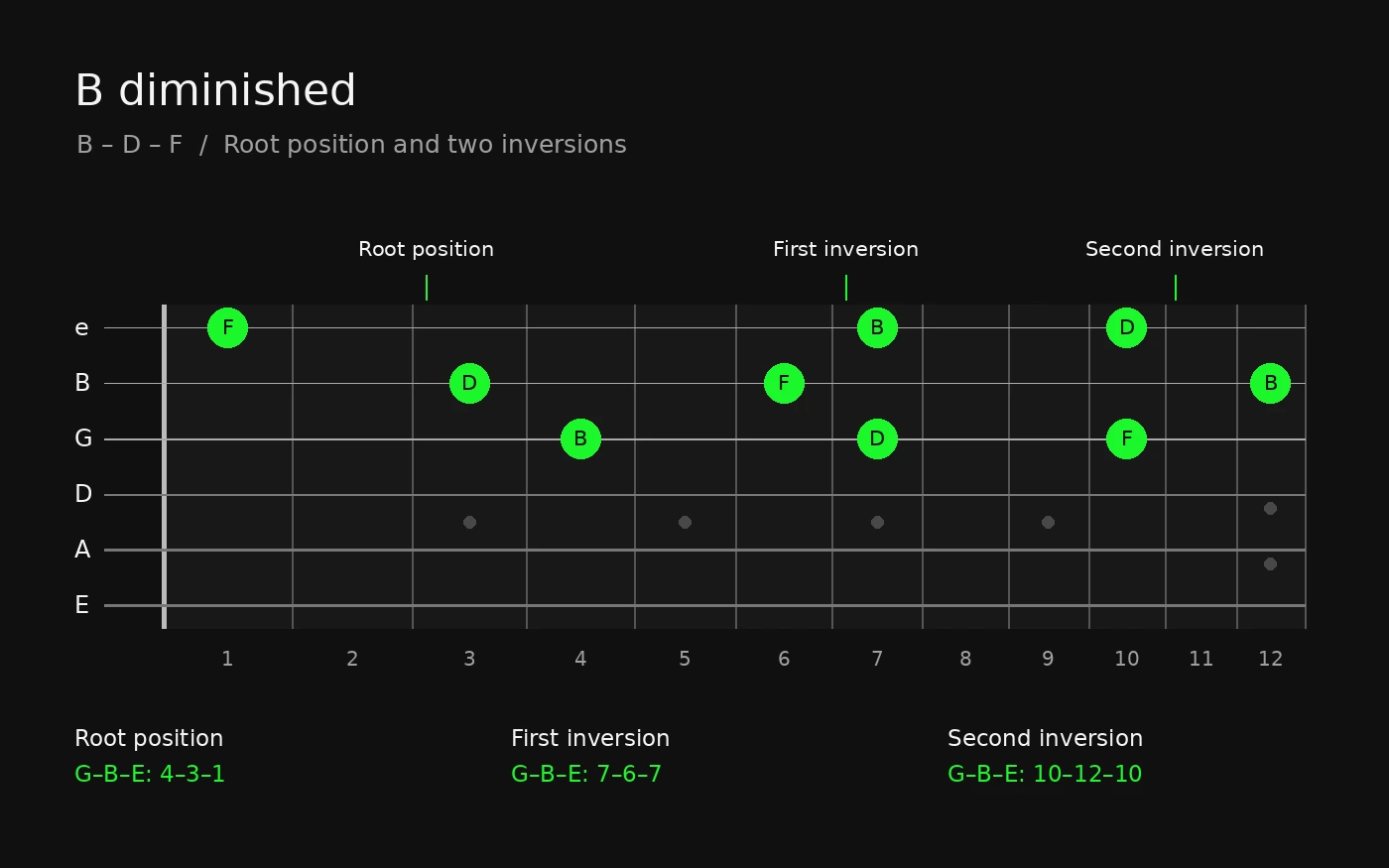
The same applies to major and diminished chords: each triad type has its own shapes, which we can move to play other chords of the same type on this string set.
These are the three positions of Em (E–G–B):
And these are the three positions of Bdim (B–D–F):
The First Twelve Frets
For now, we'll limit our search to the first twelve frets, including the open strings.
At the twelfth fret, we find the same notes as on the open strings, one octave higher. Shapes can also be moved twelve frets up the neck, provided the guitar has enough frets. If a shape includes an open string, that note moves to the twelfth fret too.
For example, the second inversion of C major appears at 0–1–0 and again one octave higher at 12–13–12. This second position goes one fret beyond our initial limit, but it shows how the same shape repeats.
What matters is understanding that notes and inversions repeat along the neck, even though our guitar has a physical limit.
What About the Other String Sets?
The guitar has a small quirk in its tuning.
From one open string to the next higher-pitched string, the distance is usually five semitones. Between the third string (G) and the second (B), however, it's four semitones.
That difference causes some shapes to change when we play them on other string sets. Even though the chord contains the same notes, our fingers may need a different arrangement.
For now, we'll study G–B–E. Later, we can repeat the exercise on D–G–B, A–D–G, and E–A–D.
3. Voice Leading Between Chords
I had a feeling the next part would blow my mind, though I wasn't sure I'd be able to learn it. I wanted to learn how to use chords in their most basic form, and I knew this was something I'd been missing. It sounds so simple, but being able to savor those interval relationships is huge.
When you can isolate a movement and hear what happens as you move from one chord to another, your musical judgment grows stronger. And it's funny: first you need to take on the role of “the listener” instead of “the player.”
For example, we can move from the second inversion of C major to the first inversion of D minor: C/G → Dm/F
Following the voices from high to low, the movement is:
- E → D
- C → A
- G → F
All three notes move down: two move a whole tone, and one moves a minor third.
This is called voice leading: the way the notes of one chord move to the notes of the next.
We can also experiment with other scale degrees. For example, C major and Em share two notes, E and G. We can keep them in the same voices and move C to B to hear how the chord changes with a shift of just one semitone.
The idea is to listen to these relationships and recognize what happens when we move forward, backward, or jump from one scale degree to another.
This exercise complements what we explored in Guitar Scale Formulas: How to Understand Them Through the Major Scale, where we used the notes of C major to hear the distances between scale degrees and understand their formulas. Here, we're still using those relationships, but we're exploring them through chords and their inversions.
4. Using Guitar Triads to Build Melodies
Another thing that blew my mind was finding all these possibilities as I moved between root position and inversions, both within the same chord and between different chords. That movement lets you develop and expand a musical motif you already have.
When we play the notes of a triad individually instead of all at once, we're playing an arpeggio. Knowing the different positions lets us move through those same notes in different registers and choose how to connect a phrase to the next chord.
For example, we can start by playing the notes of Dm in root position, move up to another inversion of the same chord, and then decide whether we want to continue to Em, return to C, or jump straight to another scale degree.
We don't have to change chords immediately. We can stay on Dm while building a short phrase, use its different positions, and then connect that idea to another chord.
We can also keep a motif, repeat its movement over another chord, or change a few notes to create a different continuation. Beyond choosing which chord comes next, we begin deciding how we want to get there.
String Skipping and Arpeggios
Knowing where the root, third, and fifth are also lets us move through a chord's notes without always using consecutive strings.
For example, we can play the root and third one after the other on the same string, skip the next string, and find the fifth on another. This is known as string skipping.
We're still using the chord tones, but we're changing the route. The distance between the notes, their register, and the order in which we play them can turn a simple shape into a different melodic idea.
Conclusion
Studying triads isn't just about memorizing chords and finger positions.
By understanding their inversions, we begin to recognize how their notes relate to one another, how they move between different chords, and how we can use them to build melodies.
For now, our study is limited to the first three strings, where we're looking to identify each chord in root position and its two inversions, recognize repeating shapes, and become familiar with their positions on the fretboard.
Later, we can apply the same approach to string sets 2–3–4, 3–4–5, and 4–5–6, keeping in mind that some shapes change because of the guitar's tuning. This will let us connect inversions across different string sets and even combine their notes to build larger chords.
Those possibilities are beyond the scope of this first study, but they start from the same principle: understanding the structure of chords so we can recognize them anywhere on the neck.
Knowing inversions lets us stop thinking only about where to play a chord and start thinking about where we want to take the music.