Breaking Down the Groove in Wurkt’s “Faithful”
August 25, 2026
by eduardoWhat gives the main riff in Wurkt’s “Faithful” its hypnotic bounce? Breaking it into a 3 + 3 + 3 + 3 + 4 pattern reveals how rhythmic displacement and chromatic movement shape its groove.
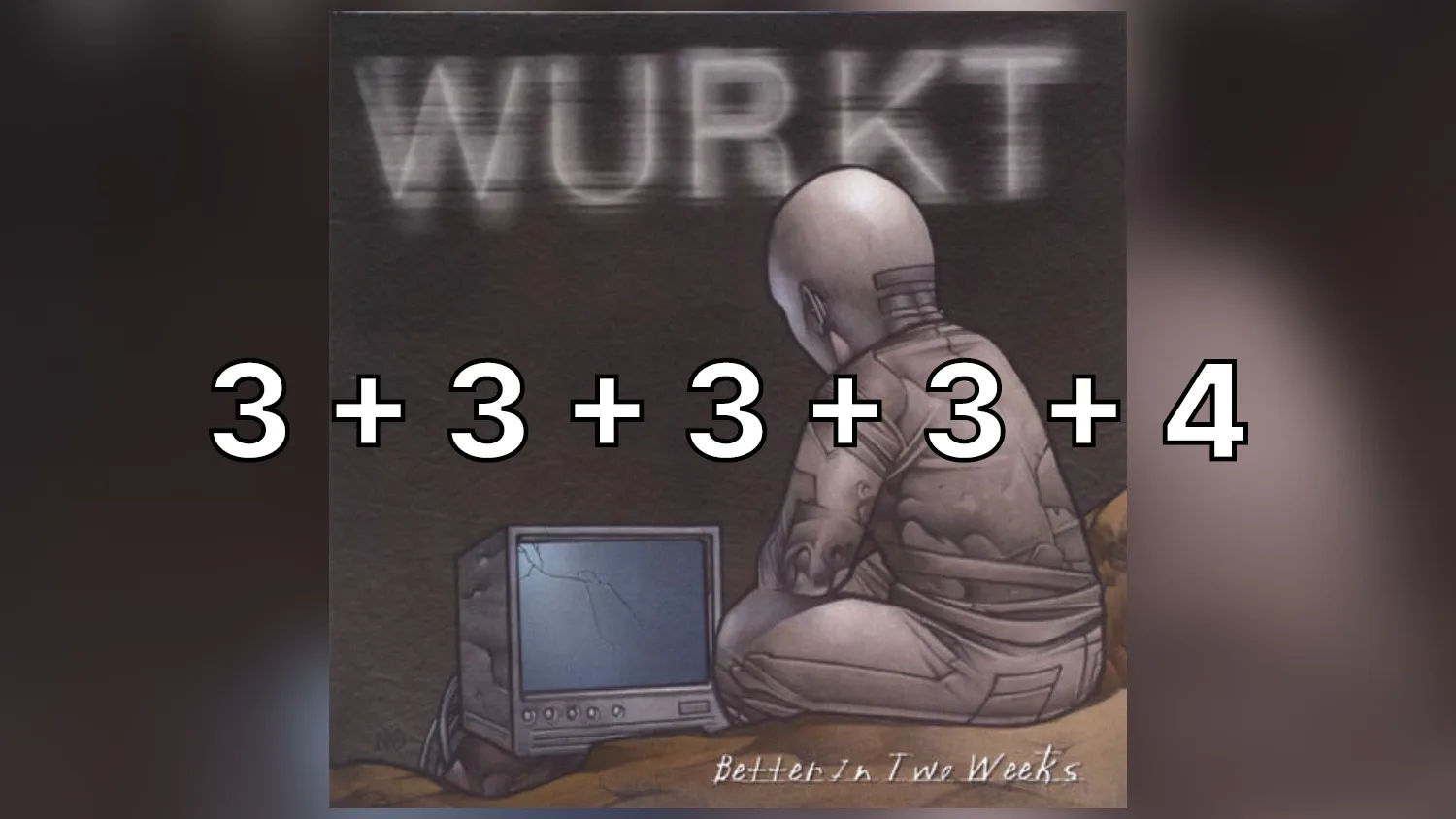
A while ago I came across a nu metal band that, if it wasn’t for the Internet, I probably would’ve never heard of. Bless the Internet. The band is Wurkt, and they have this somewhat melancholic vibe mixed with the aggression of metal. But well, everyone will have their own opinion. Listen here
The song I heard was “Faithful”, and I found the main riff pretty interesting. There’s something hypnotic and slightly dragged about it, but it still has that bounce that’s so characteristic of nu metal.
So instead of simply learning the riff note by note, I wanted to understand what was behind the rhythm and what exactly was going on.
Breaking the riff into pulses
The main riff works as an almost continuous stream of sixteenth notes with very few spaces. And what mainly changes is the pitch of the notes.
A big part of the phrasing consists of repeating one note for several sixteenth notes and then moving that same figure to the next note, often through chromatic movement.
What helped me the most in understanding the riff was to stop looking at it as one continuous line of notes and start separating it into groups based on how long each note lasted before changing.
Once I did that, the pattern became much easier to read visually:
3 + 3 + 3 + 3 + 4
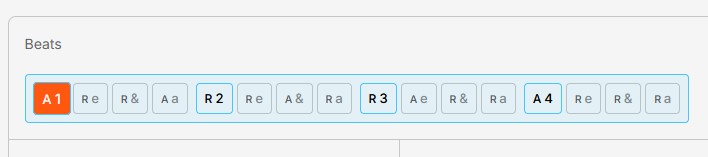
A = accent R = rest
Each number represents how many sixteenth notes a group lasts before moving to the next one. Once I separated it that way and counted each beat as 1 e & a, I could see exactly where each note change fell within the 16 sixteenth notes of a 4/4 bar.
The groups start on:
1 → a of 1 → & of 2 → e of 3 → 4
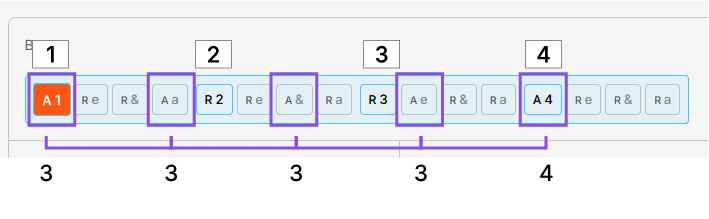
Group Starts in Dorelog’s Pulse Editor
Looking at it this way, it becomes easy to see how every new group moves through a different subdivision until it lines up with a beat again.
Instead of only seeing a succession of notes on the tablature, I could see where each movement started and ended, and how those changes moved around inside the bar.
Separating the notes and seeing how much space each movement took inside the riff was interesting, but what had really caught my attention from the beginning was how it felt when the guitar was playing together with the drums.
There was something about that groove that made a pretty continuous line feel like it had a lot of movement.
So I recreated the beginning of each group in Dorelog’s Pulse Editor, accenting them so I could hear the displacement without depending on the original notes.
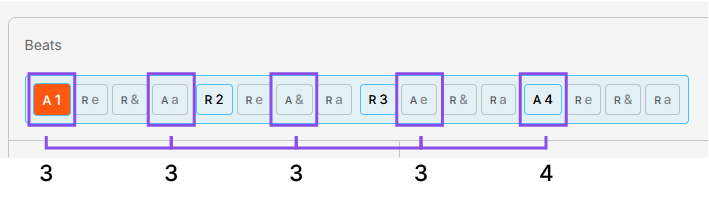
The 3 + 3 + 3 + 3 + 4 sequence becomes much clearer when we can hear the accents that define it
Once I had those reference points, I started writing small phrases that would fit between one accent and the next. The idea was to keep that movement:
1 → a → & → e
and use 4 as the point where everything reconnects before starting again.
Then I wanted to see how that would translate into a drum groove, so I took the same pattern into Cubase. I used those accents as reference points for the kick, and kept the snare on beats 2 and 4.
It immediately turned into a pretty basic groove, but with a feel much closer to hip-hop than I expected. And that was my first useful discovery:
the rhythmic skeleton by itself doesn’t sound particularly metal.
Once you separate it from the guitar, it can work perfectly well as the foundation for a completely different kind of groove.
Three riffs from the same rhythmic idea
Once I had the pattern isolated, I wanted to see if I could use it as a starting point for writing something of my own instead of simply recreating the riff from Faithful.
I recorded three short riffs, each two passes long, using the same rhythmic idea but changing the notes, the phrasing, and the way each one resolves.
The intention wasn’t to make three riffs that sounded like Wurkt, although I think one of them ended up sounding pretty similar. What I really wanted to see was how much of the groove I could keep once I took the original riff out of the equation.
And this is where the experiment became more interesting.
Even though I could reuse the rhythmic displacement, by itself it didn’t necessarily create that hypnotic, dragged feeling I liked about “Faithful.”
That made me go back to the original riff and pay less attention to the isolated pattern and more attention to what the notes themselves were doing.
The rhythm wasn’t the whole answer
Once isolated, the pattern sounded much more linear than I had imagined.
I tried moving the same grouping into other time signatures and experimented with other kinds of riffs. But by themselves, those groups of three didn’t recreate what I liked about Faithful.
That brought me back to the main riff. And that’s when I noticed something pretty obvious: the riff really doesn’t have any rests. The sixteenth notes keep moving while the pitch changes through small movements, many of them chromatic.
So there seem to be two important things happening at the same time:
A continuous, almost mechanical flow of notes that helps create that hypnotic effect.
The pitch changes are displaced against the 4/4 pulse, creating that more bouncy feeling.
That combination ended up feeling much more important to me than the grouping by itself.
I tried playing the same pattern using only power chords, even thinking of something closer to doom metal since the song is around 93 BPM.
The result changed drastically.
It didn’t necessarily sound bad, but it didn’t really convince me. With power chords, every change becomes a much more obvious event and the grouping becomes too exposed.
I also tried building a more “metal” riff using power chords, but those first groups of three happened too quickly for the kind of feel I was trying to get.
With single notes and chromatic movement, on the other hand, the rhythmic displacement can almost hide inside the line itself.
The guitar keeps moving continuously while the note changes keep landing in different places against the beat.
I think that’s where a big part of that mix between hypnosis and bounce that caught my attention in the first place comes from.
From analysis to practice
The most useful thing I got from this riff wasn’t a formula for writing another Faithful.
It was a way to separate the groove into smaller parts and see what each one was actually doing.
I could isolate the pulse, mark where the important changes happened, listen to those points without the original notes, and then build something different using the same rhythmic idea. And that’s exactly where Dorelog’s Pulse Editor became useful to me.
Instead of using the metronome only as something that goes click on every beat, I could recreate the accent points of the groove and practice that rhythmic structure.
And then take it into another context: guitar, drums, or even completely different riffs.
In the end, the result of the experiment was much simpler than I expected:
continuous movement + pitch changes displaced against the pulse + chromatic movement = a big part of the character of this riff.
The rhythmic displacement gives it that bounce.
And the chromatic line gives it a big part of its identity.