What’s Inside a 4/4 Rhythm? On-Beats, Offbeats and Anticipation
September 5, 2026
by eduardoA 4/4 rhythm contains more than four numbered beats. By moving attacks between on-beat and offbeat positions, we can hear how syncopation and anticipation shape drum grooves, guitar riffs and the feeling of forward motion.
I think I once read, “Everything is in 4/4 if you count to four,” in a Facebook comment or somewhere similar.
It’s a tongue-in-cheek line. If you insist on counting to four, supposedly every rhythm will eventually fit. But what happens when the music asks you to count to five, seven, or something else? More importantly, what gets lost when rhythm is reduced to finding the next “one”?
The joke is deliberately simplistic, but it also downplays how much nuance can exist inside a groove.
Once you can find the four beats, what else is there to understand?
Quite a lot, actually.
I enjoy understanding the relationships behind music, whether they involve intervals, harmony, or rhythm. But most of the time, the way a riff sounds matters more to me than the amount of theory I can use to explain it.
Theory can reveal possibilities, but it isn’t ultimately what convinces me to keep an idea.
The music still has to make me feel something.
We can often recognize a song from its rhythmic shape before identifying it’s theoretical justification about why it works—or even naming a single chord. Yet rhythm isn’t always studied with the same attention we give to scales, intervals, and the relationships between notes.
We learn to reproduce a groove, but we don’t always stop to examine what gives it its character.
A 4/4 rhythm may give us four familiar beats, but those beats only describe the container. Much of a groove’s identity comes from what happens between them.
What Happens Inside the Four Beats?
In a measure of 4/4, the four main beats give us a reference:
1 2 3 4An attack that lands directly on one of those beats is on the beat. Tamás Barabás also uses the term thetic for this position in his book The Rhythmic Code, but we’re calling it “on the beat.”
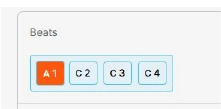
But each beat can also be subdivided. If we divide it into two eighth notes, the spaces marked by & fall between the numbered beats:
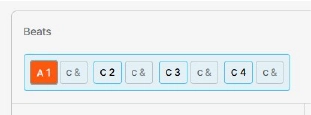
An attack placed on one of those subdivisions is off the beat, or on an offbeat.
At this point, these terms describe position only:
On-beat tells us that an attack coincides with the main pulse.
Offbeat tells us that it occurs between the main beats.
Playing on the beat is not inherently boring, and playing off the beat does not automatically produce an interesting groove. The effect depends on how the attacks are arranged, which instruments play them, and what the rest of the music establishes as a reference.
Still, moving an attack from one position to the other can change the character of a pattern—even when almost everything else remains the same.
What Changes When Offbeat Attacks Move Onto the Beat?
To hear that difference more clearly, I recreated short drum patterns inspired by three songs: “IMAGINE” by Boko Yout, “Nothing Happens Twice” by Gurriers, and “Take Your Aim” by Rocket.
These are reduced listening exercises rather than complete transcriptions. I only recreated enough of each groove to preserve its recognizable rhythmic behavior.
I then created a second version of each pattern by moving its displaced attacks onto the main beats. The tempo, drum sounds, and order of events remained as consistent as possible.
The point was not to improve or correct the original grooves. It was to hear what their offbeat attacks were contributing.
The three transformations produced noticeably different results.
“IMAGINE” — Boko Yout
In “IMAGINE,” I moved primarily the kick attacks while leaving the snares and the rest of the rhythmic reference intact. The difference was subtle. The transformed pattern did not suddenly become a stomp, but it did feel slightly more rigid.
The original groove’s displaced kick blended naturally with the other layers. Moving only that part altered the groove’s movement without destroying its identity, which also made the difference easier to overlook.
This was not a completely on-beat reconstruction of the drum pattern. But that limitation revealed something more interesting than the comparison itself—something we’ll return to when we look at anticipation.
“Take Your Aim” — Rocket
The transformed version of “Take Your Aim” also felt more imposing, but in a sharper, more segmented way. Its closely spaced snare attacks made the on-beat version feel choppier and less rhythmically animated.
It retained its force, but the groove lost some of the movement created by its displaced attacks. Once those attacks were placed directly on the beats, the pattern became more abrupt and predictable.
“Nothing Happens Twice” — Gurriers
This had the most dramatic transformation. Its original pattern included a particularly interesting kick placed shortly before the following main beat. When we “corrected” that displacement by moving it onto the beat, several kick and snare attacks ended up landing at the same moment.
The result felt heavier and more stomp-like. The number of instrumental hits did not change, but those hits were now concentrated into fewer rhythmic events.
Instead of moving around one another, the kick and snare reinforced the same points in the measure. Of the three examples, this transformation lost the most character.
An Offbeat Is a Position. An Anticipation Has a Direction.
The three transformations did not produce the same feeling. “IMAGINE” became only slightly more rigid, “Take Your Aim” became more imposing but choppier, and “Nothing Happens Twice” became distinctly stomp-like.
We do not need another classification system to account for every difference. But the subtle change in “IMAGINE” points toward a distinction that is easy to miss: identifying an offbeat tells us where an attack occurs, but not what that attack is doing.
An anticipation occurs before an expected arrival and makes that arrival feel as though it has happened early.
Compare these figures:
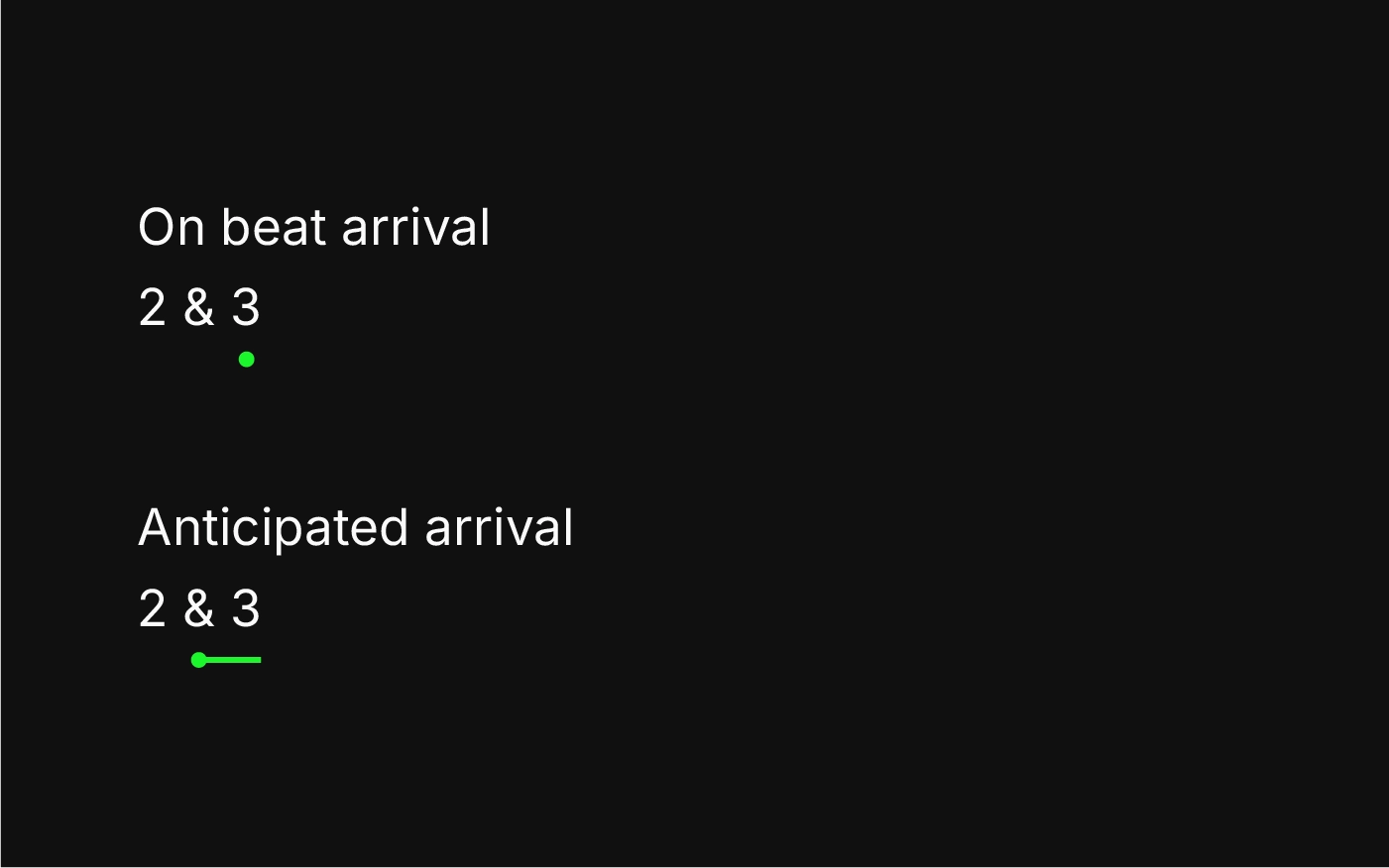
In the first figure, the note arrives directly on beat three. In the second, it arrives on the preceding offbeat and takes the place of the expected arrival. It may continue through beat three, or its musical effect may simply make us hear the event as arriving early.
This gives us an important distinction:
Every anticipation occurs before an expected arrival, but not every offbeat attack functions as an anticipation.
An offbeat is simply a position. It can contain an attack or remain empty. When we place an attack in that space, we can use it to point toward an upcoming event: a beat, a chord change, a bass note, or the beginning of the next measure.
Something similar happened in “Take Your Aim.” Its displaced kick and snare attacks created movement between the main beats. Once we placed those events directly on the beats, the pattern retained its force but lost much of the rhythmic character that made it interesting.
The effect was subtler in “IMAGINE.” In our reduction, a kick on the & before the following beat behaved like a small anticipation. Its early arrival helped the groove move forward without calling much attention to itself.
Because we moved only the kicks, the rest of the beat remained recognizable. Once that anticipated kick was placed directly on the beat, “IMAGINE” still sounded like itself—but slightly more rigid.
Rebuilding the Relationships in the Pulse Editor
Now we can remove the songs and reduce these ideas to attacks and spaces.
The Pulse Editor lets us build three related patterns:
Attacks that land directly on the beats.
Attacks that occur on the offbeats.
An offbeat attack that anticipates a specific arrival.
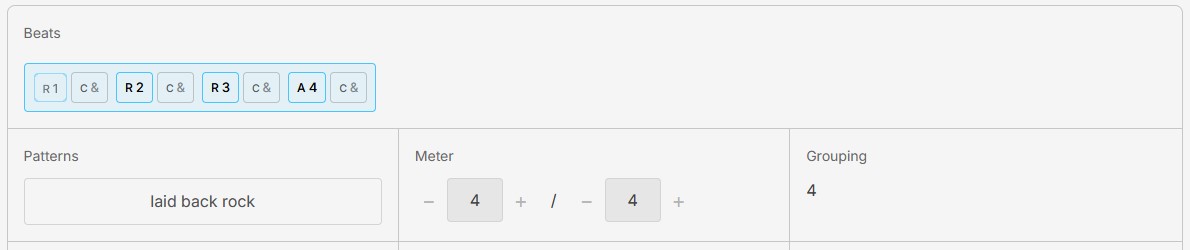
We can also change the accents on the on-beat and offbeat notes to hear each part more clearly.
Pitch and harmony are temporarily removed so we can concentrate on one question: what changes when an attack changes its relationship to the pulse?
From a Pulse Pattern to a Riff
After using the Pulse Editor to isolate these rhythmic positions, I wanted to see whether they could become something more than an exercise. I used two patterns as starting points for two short guitar ideas.
The first became a slow shoegaze progression. The second developed into a more direct, laid-back rock riff. I did not begin with the same musical intention in both cases. Instead, each one grew from the placement of its attacks; harmony, guitar tone, and drums gave it a style afterward.
Turning the Pattern Into a Shoegaze Progression
For the first guitar experiment, I used a slow, effect-heavy shoegaze sound—considerably more processed than my guitars usually are. The slower tempo helped because each chord had enough time to bloom before the next attack arrived. Instead of hearing only a sequence of short rhythmic events, I could hear each chord catching the rhythm as it passed.
The rhythmic foundation was simple. Its main chord attacks fell on the & after beat 1 and directly on beat 3. In some repetitions, I added another chord on the & after beat 4.
This meant that the guitar did not remain entirely on or off the beat. One chord was strummed on 1 &, the next landed directly on beat 3, and, in some repetitions, another arrived on 4 &, immediately before the next measure. That last position created a natural place to experiment with anticipation.
For the drum reference, I used kicks to mark the rhythmic positions. I had originally wanted the metronome to emphasize the subdivisions, but I could not configure it the way I wanted. The kicks became a practical substitute: they made the offbeat positions easier to hear while I recorded the guitars.
The slow shoegaze treatment made this experiment especially clear. Because the chords were allowed to ring, the listener could hear both the attack and the space that followed it. That made the difference between arriving on a beat, arriving between beats, and leaning toward the next measure much easier to perceive.
Letting the Click Become the Riff
My second experiment began without a particular style in mind. I followed the metronome, played different ideas, and watched where my attacks landed in relation to the grid. Some fell on the beat and others between the beats.
The process was slightly chaotic. It took me a while to decide what I wanted, and I eventually settled on a fairly simple chord progression. It is not going to break any technical barriers, but I was genuinely pleased with the result. Once I added the drums, the riff developed a soft, laid-back feeling that made it surprisingly fun to play.
The most recognizable part of the rhythmic figure occurs around beats 3 and 4.
That middle attack gives the figure a syncopated quality, but its role as an anticipation is less obvious than it was in the shoegaze example. It does not necessarily introduce the next chord ahead of time. Instead, it belongs to a compact three-hit figure that moves from an on-beat position, passes through an offbeat, and lands on the beat again.
Occasionally, I allowed the power chord’s fifth to ring slightly longer. The effect is subtle, so the anticipatory pull is not especially pronounced. What remains clear is the movement between the two kinds of rhythmic position.
I recorded the guitars twice and panned them left and right. I am still learning how to record and mix guitars, but the doubled parts made the rhythmic attacks feel wider and more deliberate.
What surprised me was how clearly the original Dorelog pattern survived the transition. The metronome click did not remain a sterile reference in the background. It came alive through the guitar, while the drums completed the groove and gave the riff its laid-back character.
Unlike the shoegaze example, this riff did not begin with a specific genre or sound in mind. It began with the placement of a few attacks. The style emerged afterward.
4/4 Is the Container
Maybe everything can be counted in 4/4. But counting the beats is not the same as understanding the groove inside them.
Moving the attacks in the three drum reductions did not change their tempo or time signature, but it changed their character. “IMAGINE” became slightly more rigid, “Take Your Aim” became sharper and less animated, and “Nothing Happens Twice” became noticeably more stomp-like.
The guitar experiments approached the same idea from the opposite direction. Instead of taking an existing groove apart, I began with a few rhythmic positions and allowed them to become music. One pattern developed into a slow shoegaze progression; the other became a laid-back rock riff that I had not planned in advance.
Along the way, the distinction became clearer. On-beat and offbeat tell us where an attack occurs. Anticipation tells us that an attack arrives early and points toward something that has not happened yet. An offbeat can create movement without necessarily functioning as an anticipation.
None of this means that on-beat playing is inherently dull or that every displaced attack makes a groove better. The experiment only shows how much musical identity can be carried by the placement of a few attacks inside an otherwise ordinary measure of 4/4.
The Pulse Editor gives us a place to isolate those positions before notes, chords, or guitar tone distract us from them. From there, a click can become a strum, a strum can become a progression, and a small anticipation can give an entire riff a sense of direction.